
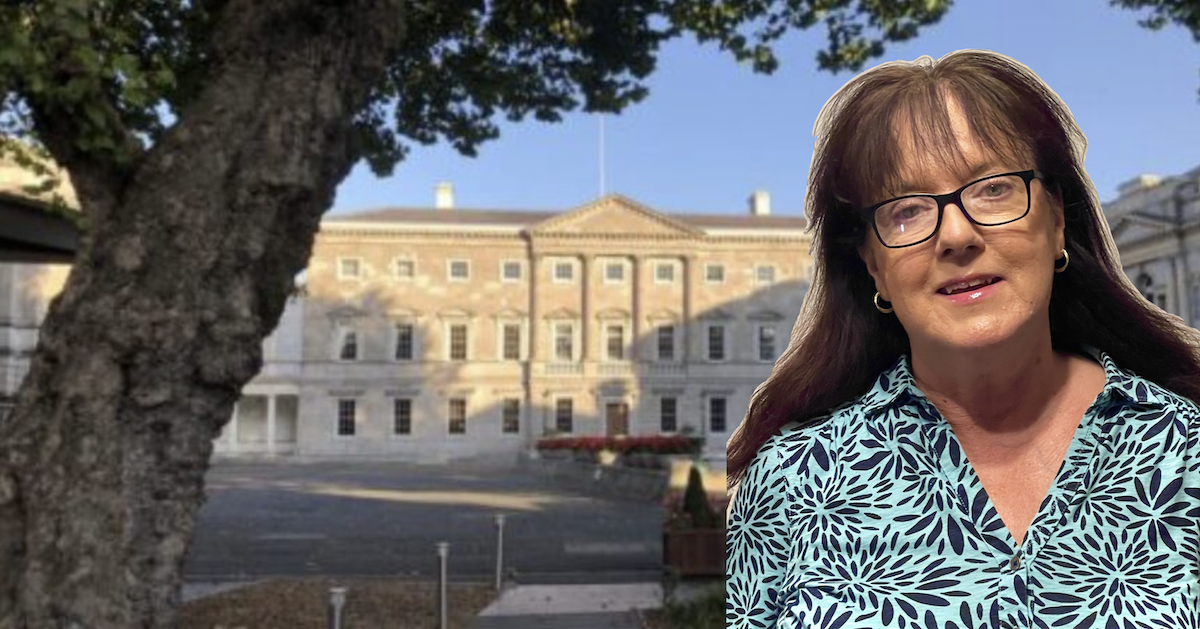
Atheist Ireland appeared at 6:30 pm today before the Oireachtas Committee on Public Petitions and the Ombudsmen to discuss our Petition ‘To give practical application to the right not to attend religious instruction in school’. It is being live-streamed on the Oireachtas website.
This is the opening speech to the committee by Atheist Ireland Human Rights Officer Jane Donnelly.
Chair and members of the Committee, thank you for inviting Atheist Ireland to address you today.
For context:
- Atheist Ireland was established in 2008.
- We are partners in the dialogue process between the state and religious and philosophical belief groups under the Lisbon Treaty.
- We have UN Consultative status, and have taken part in many reviews of Ireland under various treaties.
- We currently have three submissions with other Oireachtas Committees about the education system.
We are speaking today about a very specific issue: the failure of the State to give practical application to the constitutional right of a child to attend a publicly funded school without attending religious instruction.
This is not an abstract issue. It affects real families and it affects them in a particularly frustrating way, because the right itself is clear, but the State has largely declined to vindicate it in practice.
The Constitutional Right
The starting point is Article 44.2.4 and Article 15.2.1 of the Constitution.
- Article 44.2.4 says that legislation providing State aid for schools shall not be such as to affect prejudicially the right of any child to attend a school receiving public money without attending religious instruction at that school.
- Article 15.2.1 says that the sole and exclusive power of making laws for the State is hereby vested in the Oireachtas: That lays the responsibility and duty for this right with the Oireachtas.
Our Petition also points to the Irish text, which is important because the Irish text takes precedence. The wording used refers to attending, in the sense of being present at, religious instruction. It does not describe a weaker right to stay in the classroom but not join in, or to opt out symbolically while remaining physically present. “Teagasc Creidimh” translates directly into religious teaching.
That distinction matters, because in practice over the years this right has been steadily watered down.
What happens in practice
In most cases, when parents seek to exercise the right, schools simply supervise the child inside the religious instruction class. In some cases, schools refuse the request. The Department has said in their recent letter that; “practical considerations involving available space, supervision requirements and class arrangements’ are not ‘a cause or reason for not facilitating parental request.”
In other cases, particularly at second level, schools and the Department say that what is being taught is religious education rather than religious instruction, and therefore the Constitutional right is not engaged. The Department’s policy (Circular Letters) states that withdrawal does not arise in those circumstances.
This is despite the fact that the Oireachtas amended Section 5 of the Intermediate Education (Ireland) Act 1878 in order to introduce exams in religious education at second level. Section 5 had banned exams in religious instruction.
Our Petition argues that the Department’s approach has no sound Constitutional or legal basis.
Religious Instruction in Law
The Oireachtas itself has recognised the category of religious instruction in legislation.
- Section 30(2)(e) of the Education Act 1998 says the Minister shall not require a student to attend instruction in any subject contrary to conscience.
- The older Intermediate Education Act of 1878, which remains in place, makes State payment conditional on children not being kept in attendance during religious instruction against parental wishes, and on the timing of such instruction being arranged so that children who do not remain are not excluded from the advantages of secular education.
That older section is striking, because it shows that this issue was understood long ago not just as a matter of formal exemption, but as a matter of practical equality. A child who does not attend religious instruction must not be excluded, directly or indirectly, from the benefits of the secular education provided by the school.
Yet that is exactly where the present system is failing.
The Oireachtas is Responsible for the Right
Parents are commonly told that schools do not have the resources to supervise children elsewhere, or offer them another subject and therefore the child must remain in the religion class. That effectively turns a Constitutional right into an optional extra, dependent on local goodwill, staffing levels, or funding. But Article 44.2.4 does not say that the right exists only where convenient. It says that State funding must not prejudice that right.
That is why we say this is not simply a Patron body or school-level issue, and not simply a matter for the Department to put in place policy.
Our Petition stresses that, because the Constitution frames this right in the context of legislation providing State aid, the Oireachtas bears responsibility here. The Minister may administer the law, but neither the Minister, Patron bodies nor schools can redefine or dilute a Constitutional condition attached to public funding. The Supreme Court has made clear that the State cannot free themselves from the restraints of the Constitution or transfer away their responsibilities unless the Constitution expressly allows it.
Other Relevant Case Law
There is also relevant case law on the broader educational context.
- Justice O’Donnell in the Burke case on the leaving certificate and Covid, held that Article 42 conveys the sense that the State cannot interfere with the right of parents subject to the Constitution.
- The Supreme Court held in the Campaign case in 1998, that parental rights under Article 42 must be read in the context of Article 44.2.4.
- The Court of Appeal in the Burke case, in relation to the Leaving Cert and Covid, confirmed the continuing authority of that case and described the relationship between parents, the State and the child as a Constitutional trifecta of rights, duties and powers.
The courts have made clear that this right is not under the control of any Patron body or school to define and implement according to their ethos.
So this is not a niche issue. It sits within the Constitution’s wider structure on education, conscience, and State obligations.
Responses to Our Raising this Issue
Over the years, we have raised this issue with national and international bodies.
There is international support for action. In 2023, the UN Committee on the Rights of the Child urged Ireland to establish statutory guidelines to ensure children’s right not to attend religion classes. That recommendation is important because it focuses exactly on the practical gap we are describing today: the difference between nominal rights on paper and enforceable rights in everyday school life.
At national level, too often, the responses have been no response, an acknowledgement, or an attempt to describe the matter as policy. But a Constitutional right is not a policy option. And saying that a one-size-fits-all solution does not suit everyone is not an answer to the fact that no practical application is being given to the right at all.
Three months ago the Minister’s Office asked us to send them a three point agenda for a meeting with the Minister for Education. Last week we were informed that this meeting will not go ahead as planned as Minister Naughton was too busy.
We also want to stress that this is not an argument against religion, or against religious people. We have worked on these issues with minority religions. It is an argument for the State honouring its own Constitution in schools that receive public money. A publicly funded school system must be able to accommodate children of minority religions and philosophical beliefs on an equal basis.
This is a minorities issue, a conscience issue, and a rule-of-law issue.
What We are Asking
We are asking this Committee to recognise four simple points.
- First, the Constitutional right exists and its wording is clear.
- Second, the State is not currently giving that right practical effect.
- Third, the Oireachtas should act to ensure that all publicly funded schools, primary and second level, must have a clear, workable, and properly resourced means of enabling children not to attend religious instruction without educational disadvantage.
- Fourth, the Constitutional condition for state aid to schools under Article 44.2.4 should be reflected in legislation and the Oireachtas must have oversight of it.
In other words, the State should stop pretending that a child has meaningfully not attended religious instruction when that child is still sitting in the class.
If a Constitutional right exists, it should work in the real world.