

Over a million (or one in every five) Irish people either said they have no religion (14%) or declined to state a religion (7%) in the most recent census. In reality, the evidence of day to day life, including Church attendances, indicates that far more than one in five Irish people are not religious.
This continues a consistent pattern of Irish society becoming more pluralist, and the need for a secular state to protect everyone’s rights. In particular, we must remove Church control of state-funded schools, and allow conscientious atheists to become President, Judge, or Taoiseach.
In the 2022 figures, 740,000 people (14.4%) either ticked ‘No Religion’ or wrote in atheist or agnostic. This is up from 480,000 in 2016.
Another 345,000 people (6.7%) declined to answer the religion question. Some of these might be religious, but not want to be identified as religious, but certainly not all of them.
The figure for Roman Catholics has dipped to 69%, despite a leading question that artificially inflates the number of religious responses by asking ‘What is your religion, if any?’ instead of the more neutral ‘Do you have a religion?’ or the more useful ‘Do you practice a religion?’
Of significance to Atheist Ireland, the census found that the 25 to 29 age category were less likely to be Roman Catholic (53%) than other age groups. This is also the age cohort with the highest proportion of people with no religion (26%) and the age group most likely to become parents of new schoolchildren in the next 5-10 years.
In a 2025 survey by Amárach for the Iona Institute, of every ten Irish people, only one now says they are religious only, three say spiritual only, and another two say they are both. Another three say they are neither, and one doesn’t know. Only three in ten Irish now say they are religious.
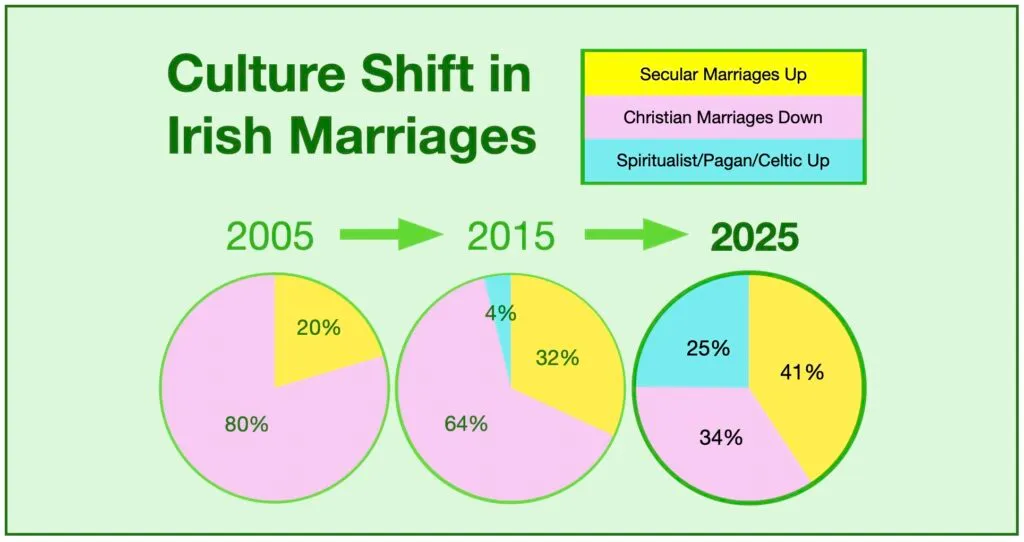
Of every ten Irish marriages, four are now secular. This is twice as many as twenty years ago. Within this, Civil Registry marriages are now the most popular. In the two years from 2023 to 2025, they rose from a quarter of all marriages to a third.
Just over a third of Irish marriages are now Christian. This is down from a massive eighty percent twenty years ago. Within this, in the two years from 2023 to 2025, Catholic marriages have dropped from most popular at four in ten, to second place with three in ten.
Almost a quarter of Irish marriages are now some variation of Spiritualist, Pagan, or Celtic. This is up from zero twenty years ago, and up from twenty percent in 2023. These are legally classified as religious, but are very different to traditional religious weddings.